
AI-powered Social Startups Still Need to Prove Themselves
Author: @trishagupta30

When dating apps first emerged in the early to late 2010s, there were (rightful) reservations regarding whether or not people would be able to form such deep connections online. The very idea of swiping through a stranger’s profile curated by an algorithm once seemed absurd, but lo-and behold years later: Hinge, Bumble, Tinder are all staples in peoples’ everyday lives. Hinge itself has grown rapidly from $8 million revenue in 2018 to $550 million in 2024. There is no doubt that what was once deemed abnormal in consumer products is the new normal.
What does this say about AI-powered social networking startups that are emerging? Are social AI companies that are directly targeting consumers going to risk being absorbed as features rather than surviving as independent products?
The truth is, we are very much still in the phase where we don’t fully trust AI to help us form human connection. According to Menlo Ventures’s 2025: The State of Consumer AI report, of the 5,000 US adults surveyed, large percentages of adults engage in social behaviors such as staying in touch, exploring spirituality, making new connections (virtual/ in-person), and dating on a daily basis. Yet only 9-14% of these people use AI to do so (depending on the category). Thus, we get this wide adoption gap between human-need-for vs. AI-enabled connection. As the data emphasizes, AI is not yet a default tool for our social or emotional needs. There is still hesitation in relying on it as a tool that deeply understands personal connection, the nuances of emotions, and context (Menlo Ventures).
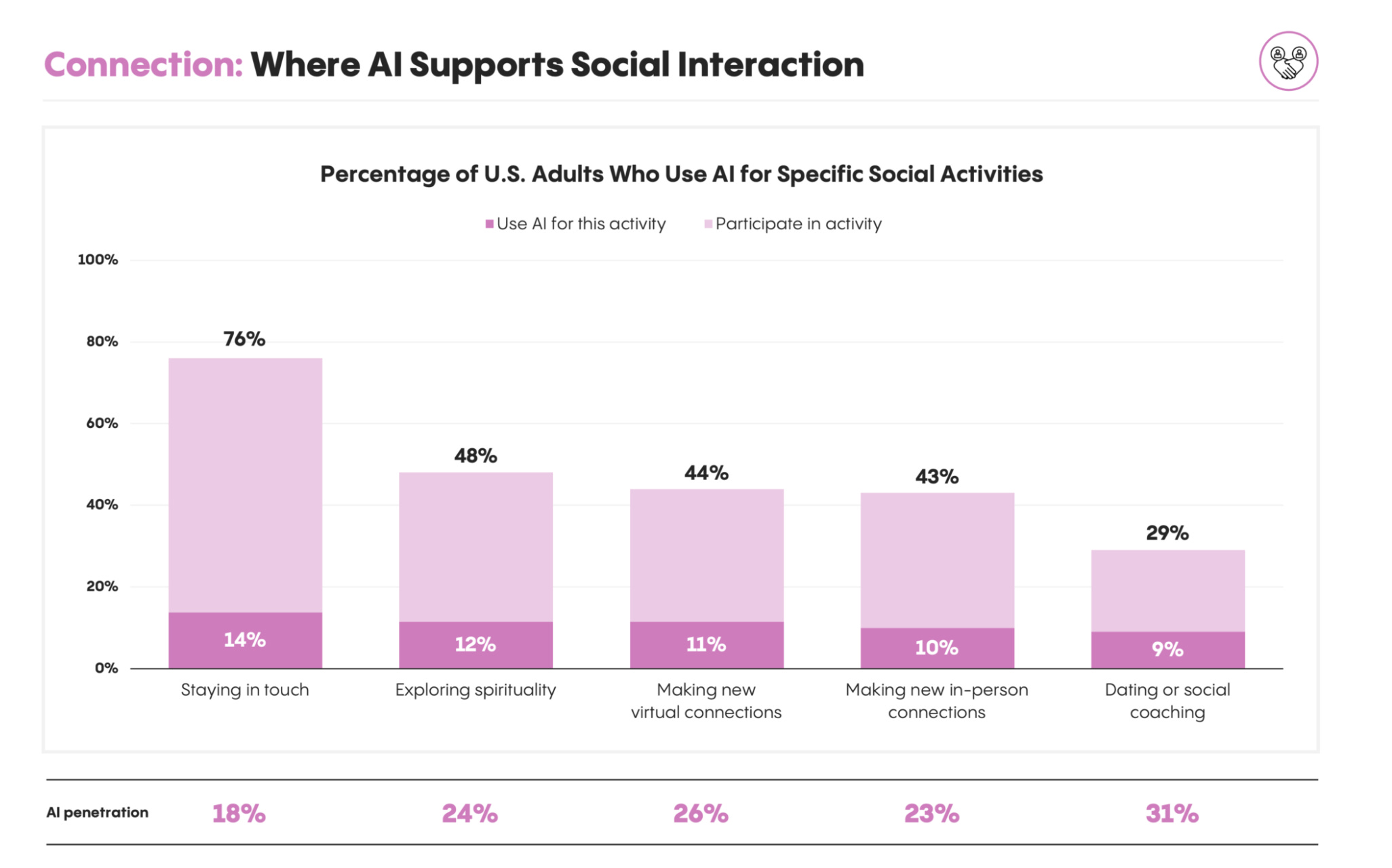
Skeptics of these AI-powered social network startups such as Chi-Hua Chien, co-founder and managing partner at Goodwater Capital, argue that “the reason that people enjoy social networking is the understanding that there are real humans on the other side.” This slow adoption may be tied to users being uneasy with AI mediating or simulating social presence - especially as authenticity can be so crucial to their experience online (TechCrunch).
So, should VCs invest in these social startups?
The answer depends on what exactly these startups are aiming to address. As the data shows, we are still not fully trustworthy of using AI to become a companion itself and aren’t actively using it to build authentic connections. Where VCs should focus their attention on are opportunities for AI to heavily personalize matchmaking, to strengthen connections that are already formed by human-to-human interaction, and to make it easier to discover new people to connect with.
We are not ready to replace human connection and social AI won’t win by simulating relationships. Instead it may just emerge as the next big thing by making them easier to find, build, and sustain.
Written By: Trisha Gupta